
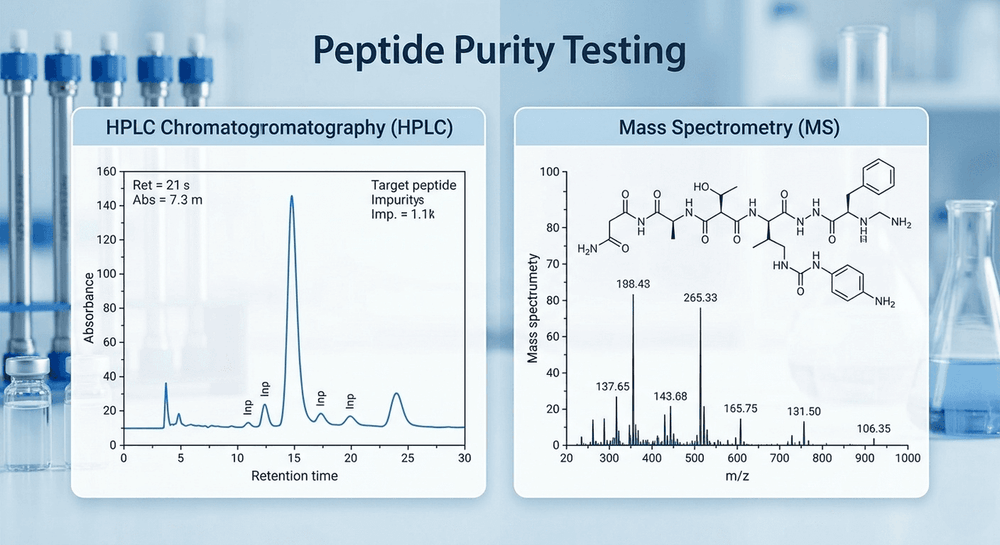
Peptide purity testing methods include High-Performance Liquid Chromatography (HPLC), mass spectrometry, amino acid analysis, and capillary electrophoresis. HPLC is the gold standard, achieving 95-99% purity verification through reverse-phase separation. Mass spectrometry confirms molecular weight and identifies impurities, while amino acid analysis validates sequence composition. Research peptides require ≥98% purity verified through multiple techniques to ensure experimental reliability and pharmaceutical-grade quality standards.
HPLC Peptide Testing
HPLC uses reverse-phase chromatography where peptides interact with hydrophobic stationary phase (C18 or C8 columns) and polar mobile phase containing water, acetonitrile, and trifluoroacetic acid. The mobile phase gradually increases in organic solvent concentration, causing peptides to elute based on hydrophobicity.
UV detection at 214nm or 280nm monitors elution, creating a chromatogram showing peaks for each component. Purity percentage equals target peptide peak area divided by total peak area, multiplied by 100. A peptide showing 98.5% purity has 1.5% impurities from truncated sequences or chemical modifications.
Modern HPLC systems achieve resolution sufficient to separate peptides differing by a single amino acid, making it the preferred method for routine peptide quality control in research laboratories.
Mass Spectrometry for Peptide Analysis
Mass spectrometry confirms molecular weight and identifies impurities by measuring mass-to-charge ratios. MS detects deletion sequences, amino acid substitutions, and chemical modifications that HPLC might miss. ESI-MS (Electrospray Ionization) and MALDI-TOF (Matrix-Assisted Laser Desorption/Ionization Time-of-Flight) are common techniques.
Mass spec provides complementary data to HPLC, offering molecular-level characterization that verifies peptide identity. This dual-method approach ensures comprehensive peptide quality assessment, meeting pharmaceutical development standards.
Amino Acid Analysis and Capillary Electrophoresis
Amino acid analysis hydrolyzes peptides into individual amino acids, then quantifies each residue to verify sequence composition. This method detects substitution errors and confirms the peptide formula matches the intended design.
Capillary electrophoresis separates peptides based on charge-to-mass ratio in an electric field, offering high resolution for closely related impurities with minimal sample volume. CE is particularly effective for charged peptides and small peptide fragments.
Testing Peptide Purification Success
Successful peptide purification is verified by comparing pre- and post-purification samples using analytical HPLC. Key indicators include increased target peak area percentage, reduced or eliminated impurity peaks, sharp symmetrical peak shapes indicating homogeneous product, and mass spectrometry confirmation of expected molecular weight within 1-2 Daltons.
Laboratories often perform iterative purification cycles, testing after each round until achieving target purity specifications. This ensures the purifying peptides process effectively removes contaminants while maintaining peptide integrity.
Common Purification Techniques
Reverse-phase HPLC is the most common purification method, separating peptides by hydrophobicity using C18 or C8 columns with acetonitrile gradients. Ion exchange chromatography separates based on charge differences, useful for peptides with significant charge variation.
Size exclusion chromatography separates by molecular size, effectively removing aggregates and dimers. Affinity chromatography uses specific binding interactions, highly selective for peptides with appropriate tags. Most commercial peptide purification employs RP-HPLC, sometimes combining with IEX for challenging separations.
Calculating Peptide Purity from HPLC Data
Calculate purity by integrating all chromatogram peaks, identifying the target peak based on retention time and mass confirmation, then applying: Purity (%) = (Target Peak Area ÷ Total Peak Area) × 100.
Example: Target peak area = 9,850, total area = 10,000. Purity = (9,850 ÷ 10,000) × 100 = 98.5%. Most analytical software calculates automatically, but manual verification ensures accuracy and identifies potential integration errors.
Quality Standards and Certificates of Analysis
Reputable suppliers like NuScience Peptides provide research-grade peptides with verified ≥98% purity, including Certificates of Analysis (COA) documenting HPLC chromatogram, mass spectrum, peptide sequence, molecular weight, purity percentage, and storage recommendations.
Comprehensive quality control includes batch consistency testing across multiple vials, stability monitoring under various storage conditions, and endotoxin testing for cell culture or in vivo applications. Researchers should verify supplier quality standards and request COAs before purchasing to ensure reliable experimental results.
Conclusion
Peptide purity testing methods: HPLC, mass spectrometry, amino acid analysis, and capillary electrophoresis, ensure research peptides meet quality standards for reproducible scientific results. HPLC remains the gold standard for quantitative purity assessment, combined with mass spectrometry for comprehensive molecular characterization. Understanding these testing methods helps researchers evaluate peptide quality, interpret analytical documentation, and select appropriate suppliers for their experimental needs.
Disclaimer: This content is for educational purposes only and does not constitute medical advice.

